View the exhibition catalog here.
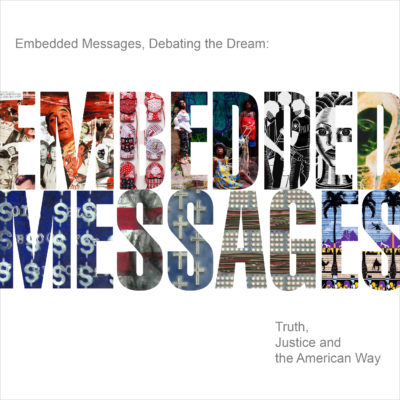
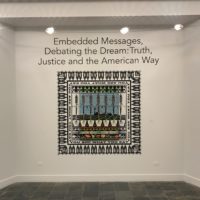
Embedded Messages, Debating the Dream: Truth, Justice and the American Way
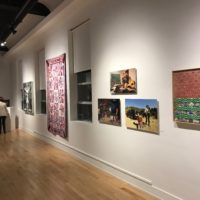
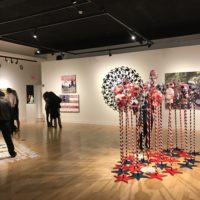
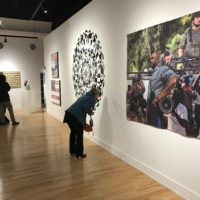
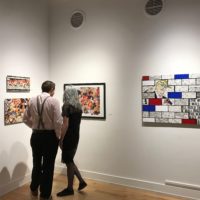
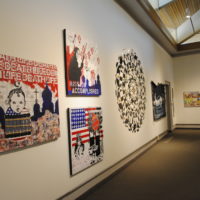
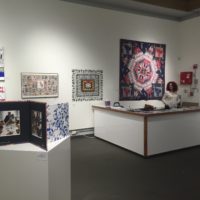
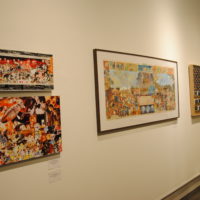
This exhibition examines the current political climate in regards to social justice — what is happening with America, can we still identify the American dream and if so, who does the dream apply to?
This exhibition was hosted by the University Art Gallery, University of Redlands, CA from October 18 –November 12, 2016 and The Art Center, Highland Park, IL in March 2017.
Truth, justice and the American way seem to be rapidly fading along with the notion of the American Dream. And American Exceptionalism is riddled with a lot of exceptions. The easy-on-the eyes mythology of America’s past injustices keep us in a troubling state of denial in the present unless we actively confront the barriers of racism, sexism, income inequality, and injustice that continue to impede full participation in the American Dream for many who feel disenfranchised. At the same time the American Exceptionalism continues to be sold to the public as we to see ourselves as the model for the world with American dreams to become global ones.
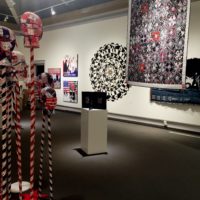
This exhibition featuring artists Sally Edelstein, Justyne Fischer, Karen Gutfreund, Penny Mateer, Sinan Revell, Debra Thompson, Linda Vallejo and Margi Weir is particularly timely as we go into an election year. With polarized political parties and the absurdity of the news media focusing on sound bites with biased editorials rather than real news, this collection of art addresses issues of social justice stimulate dialog on truth, justice and the American Way. The work serves to educate and sensitize the viewer to various issues while conveying an underlying philosophy of collective responsibility and commitment to change.
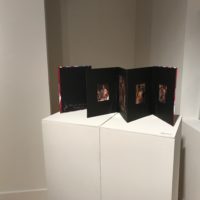
In today’s complicated sociopolitical climate, representing both positive and negative aspects of American cultural and economic influence, Embedded Messages, Debating the Dream casts a critical eye and is both a reflection and a statement about issues and events on domestic and international affairs. The topics and issues are vast: racism, sexism, classicism, sexuality, gender identity, immigration, poverty, the environment, violence, and the ongoing wars. The work is unified by topic and with the “embedded messages” running throughout, invites the viewer to delve in closer to look, learn and discuss the inherent meanings. All is not as it appears on the surface. The messages are delivered with irony, humor, pain, defiance and strength, to reflect not only their diverse personal views and opinions, but to raise critical consciousness and encourage social change.
Social injustice has long motivated artists to create works of art as a form of social commentary and protest. The works in this exhibition speak volumes and question the traditional boundaries and hierarchies of culture as represented by those in power. Although each artist’s specific approach and goals are distinct, their works, especially experienced together, invite conversations that will appeal to a wide range of audiences. Viewers will become participants as they explore the embedded messages that stimulate critical thinking and open their pathway to potential answers and solutions.
We acknowledge the power of art to affect positive change. We believe that our voices will help to foster important dialogues about economic, political and social equality, race, justice, human rights and bias in the United States and worldwide. We hope we will be given the opportunity to share our exhibition with your community!
Press for Embedded Messages from the Redlands Daily
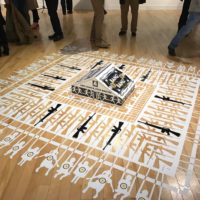
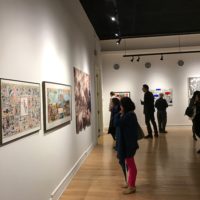
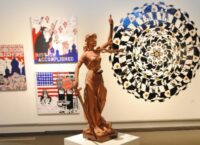
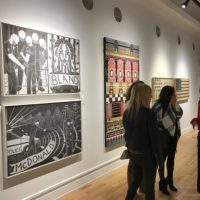
Artist Statements:
Sally Edelstein: Never was the American Dream more potent or more seductive than in mid-century America when corporations, advertising and the government banded together in a consensus of the good life. This series of collages examine a set of once cherished beliefs forged during the heady post war years when myths were churned out as rapidly as they did Chevrolets, offering a glimpse into the consumer culture that helped define the fairy tale American Dream and the possibility of its attainment. In this age of diminishing expectations as the middle class disappears like a faded Kodacolor print and the American Dream itself has gone into foreclosure it is instructive to take a look back at a time when these myths were created, The contrast between todays lowered expectations and the unduly heightened ones that preceded it form some of the subtext of the work. At the same time, American Exceptionalism was hawked to us with a can do optimism as America saw itself as the model for the world and American Dreams were to become global ones. While our soaring confidence promised us a sugar coated world of possibilities it also co- existed with the very real fear of nuclear annihilation. I would catch a cold war chill I could never shake.
Justyne Fischer: Through the use of bold and simplified yet complex imagery, I use the medium of woodcut to illustrate specific unjust events involving unarmed Black men, women and boys. It is my hope that these works will memorialize these moments and create awareness that can possibly lead to resolution. Each piece tells a story revealing my interpretation of what occurred or what may have occurred specifically in veiled instances. Suspicious Suicide reveals the possible circumstances and unanswered questions surrounding Sandra Bland’s death while in Texas police custody. Traffic Target reveals the manner in which Walter Scott was targeted and shot in the back by a reckless South Carolina police officer for simply having a tail light out on his car. Rough Ride represents the unexplained, unjustified and deadly transport of Freddy Gray in a Baltimore police van. Loosie Law represents a wild west, cowboy mentality in New York State where Eric Garner was choked to death. Severe and irreversible punishment did not match the crime. Two Seconds is the amount of time it took for an erratic Cleveland cop to assess and kill a twelve year old boy with judgement. The banana in the boys hand is meant to highlight the innocence of Tamir Rice while referencing ingrained institutional racism. Walking While Black features William Wingate who was arrested and jailed by Officer Whitlatch for walking while Black. A golf club cane was viewed as a weapon in the skewed eyes of a biased beholder. The Sunshine State represents striking yet simplified imagery which highlights Florida’s backward practice of “strange fruit” or modern day lynching’s through gun violence against Jordan Davis and Trayvon Martin. White men stand their ground, Black boys get gunned down.
Karen Gutfreund: My work is art as activism. This “War” series of work is my reaction to the ongoing wars over the control of oil and natural resources within our consumer-based culture. I examine the juxtaposition of religious mantras and the resulting consequences of war and perceptions of freedom to obtain power over these resources. The layers of images with mixed meanings and text, often biblical, are meant to provoke the viewer’s visceral senses to evoke change. Then using hot political issues, I mix it up with text, pop culture images, stencils, and symbols to create works that are a combination of personal commentary, religious and moral teachings, political outrage and social observation. These works reveal the layers and inner complexity of my dreams, nightmares and emotions and to confront who we are and where we are going in a culture of exile and alienation between race, religion and political dogma in our turbulent society.
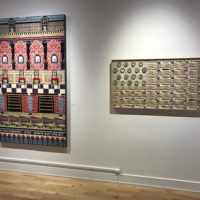
Penny Mateer: I am inspired by the use of pattern in quilting and the decorative needle arts and honor the tradition of stitching often thought of as “women’s work.” Drawing from this rich and shared history of creating functional objects intended to provide warmth and comfort, I use the medium as a platform to present ideas about current events. Because I choose fabric as my primary material I can establish an immediate connection through shared experience, we all need to wear clothes we all need to stay warm. My challenge is to find graphic, commercial fabric and then use it in unexpected ways. By manipulating, pattern, color and texture using a universal material I create a safe space in which to challenge long held beliefs and assumptions. Moving from appliqué to collage I have started a series based on newspapers because I am greatly concerned by the gradual shift from handheld newspapers to the digital delivery of news and how that diminishes the impact of photojournalism. Unlike reading the news on a computer screen the act of holding a newspaper forces the reader to see an image even if just a glance. In contrast to the labor-intensive processes of quilt making and needlework the benefit of working with newspaper collage and large format and commercial printing, is the ability to respond to current events and convey my ideas immediately.
Sinan Revell: When I moved from Australia to the USA in the 90’s, I observed at first hand the cultural aspects I had mainly seen in American movies-the affluence, the color divide, the violence and the seductive consumerism. Following the events of 9/11, I could no longer ignore the constant media barrage on our, minds, senses and desires. From this politicized perspective, I created the DoppelgANGER series and Homeland Security Blanket series. This series of self-portraits was conceived to express the idea that we can no longer be innocent or ignorant of our personal and global connectedness. I selected locations and staged dioramas, often of famous images- not to glamourize or mythologize our alter egos, but to hold a mirror up to our darker sides. Fame or Infamy are both equally desired. Victim/Aggressor, Judge/Jury – we are surrounded by these dichotomies. Ultimately, we are capable of being both, given the right circumstances. By putting myself into the picture as all the characters, I erase the Power of the ego and postulate the notion of chance.
Debra Thompson: Visual Discourse is a series of works based on the social and political issues that have challenged America within the current decade. Each individual piece of art reflects a dilemma that is expressed using assemblage of ordinary objects or messages on the underlying organizing structure, the American flag. The objects or words are selected because their juxtaposition signals a particular social or political point of view. Visual Discourse is an on-going series that currently addresses issues such as corporate sugar and health; women’s reproductive rights; financial greed; Sandy Hook tragedy; institutionalized pedophilia; and coming: big Pharma, guns, and race.
Linda Vallejo: It has taken my entire artistic career to fuse an image that defines my multicultural experience of the world and my place in it. Like most of my contemporaries I was taught the finer points of the Western classics, art and architecture, but later found myself living and creating in a milieu where symbols of beauty and culture were manifest in a decidedly alternate circumstance. Make ‘Em All Mexican leads you down an ironic path to find yourself confronted by some of the most difficult questions of our time, “Do race, color, and class define our status in the world?” “Is it possible to be a part of and earnestly contribute to multiple cultures simultaneously?” “Does color and class define our understanding and appreciation of culture?” I found myself ruminating, “I’m a person of the world. What would the world of contemporary images look like from my own personal Mexican-American, Chicano lens?” I found myself furiously painting directly on antique photographs and figurines to deconstruct iconic images to create an America that included me. The Make ‘Em All Mexican series carries a strong electric charge. I have re-created a familiar world to create a new unfamiliar image, one that is unfamiliar to everyone that’s not Mexican….
Margi Weir: In my studio practice, I use a computer to repeat images that I stitch together visually in order to make an appealing pattern, often resulting in tapestry-like, spatially flattened compositions. This references pre-Renaissance and/or non-western methods of pictorial organization, for storytelling purposes, that were used in textiles, ceramics, and architectural decoration. Through decorative patterning, the work of art draws the viewer into a slowly unfurling image that invites a discussion about ecology and/or sociopolitical realities of the contemporary world around us. Meaning is implied by the juxtaposition of images not stated in narrative fashion. Conclusions are left to the viewer in the hope that a continued questioning will be inspired by the work of art.